
Designing wallpaper patterns that repeat perfectly
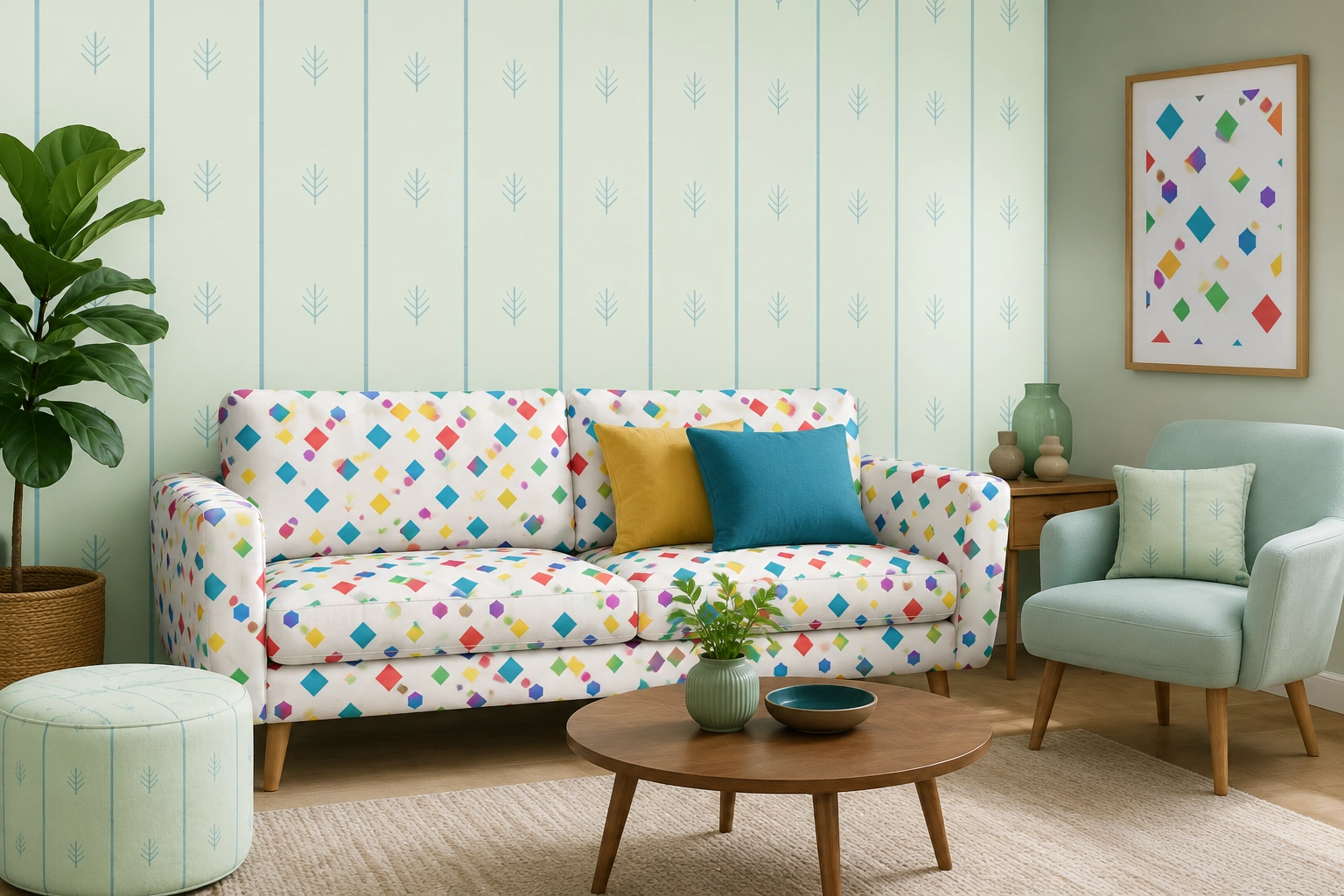
Wallpaper is a seamless pattern at its most ambitious. It has to tile flawlessly across a whole wall, hold up when strips are hung side by side, and still feel calm to live with. Modern print-on-demand wallpaper services mean you can now design a feature wall in your browser and have it printed to order, no design studio required.
The repeat has to be truly seamless
Wallpaper is printed in long drops that are hung next to each other, so any mismatch shows up as a hard line running floor to ceiling. This is where a genuinely seamless tile matters most. Because PatternMaker wraps every motif that crosses a tile edge, adjacent strips line up automatically, and the wall reads as one continuous surface rather than a grid of panels.
Choose a repeat you can live with
A wall is a large, close and permanent surface, so restraint pays off:
- Calmer is easier to live with. A busy, high-contrast pattern that looks great as a thumbnail can feel overwhelming across a whole wall.
- Mid-scale repeats suit most rooms. Very small motifs can read as noise from across a room, while very large ones need careful placement so they do not land awkwardly at the ceiling or skirting.
- Consider the room. Soft tonal patterns open a space up, while richer, darker designs make a cosy feature wall.
Where the pattern meets the room
A wall is never the clean rectangle it is in your head. There is a ceiling line at the top, skirting at the bottom, and usually a door frame, a window reveal, a light switch or a radiator somewhere in the middle. Your pattern will be cut by all of them, and you do not get to choose where.
This is the strongest practical argument for a smaller or mid scale repeat. When motifs are modest and evenly spread, a cut through the middle of one is barely noticed. When a single motif is a foot across, having it sliced in half at the ceiling, or bisected by a socket, is the first thing anyone sees. If you are set on a large scale design, keep the composition even rather than centred, so there is no obvious focal point to land in the wrong place.
Peel and stick or traditional paste
Most print on demand wallpaper comes in two forms, and the choice affects what you should design as much as how you hang it.
- Peel and stick is a self adhesive vinyl or fabric backed material. It is removable, which makes it the usual choice for rented homes, and it is very forgiving to install because you can lift and reposition a drop that goes on crooked. It tends to have a slight sheen, which can flatten very subtle tonal patterns.
- Traditional pasted paper generally gives a better surface finish and a more matte, paper like appearance that suits delicate designs. It is permanent for practical purposes, and less tolerant of installation mistakes.
Whichever you choose, buy a sample of the actual material rather than judging from a screen. The same design can look crisp on matte paper and slightly plasticky on a glossy vinyl.
Measuring and ordering
Wallpaper is sold either as rolls of a fixed width or as made to measure panels sized to your wall. Either way the arithmetic is the same: measure the width of the wall and its height at the tallest point, since floors and ceilings are rarely perfectly level, and add a margin for trimming at the top and bottom. Most suppliers recommend a healthy allowance of extra material, and running short partway up a wall is a far more expensive mistake than ordering a little too much.
Order everything you need in one go. Colour can vary slightly between print runs, so a roll ordered later to patch a gap may not match the wall it is joining.
Think about the room itself
Kitchens and bathrooms bring steam, splashes and temperature swings, so check that the material you choose is rated for humid rooms before ordering. Direct sunlight fades pigment over time, and strong, saturated colours tend to show that fading more obviously than soft ones, which is worth knowing for a south facing wall. In a small room, a busy dark pattern will close the space in, while a light, open repeat keeps it feeling larger.
Colour and light
Colours read differently across a big surface and under changing daylight, so keep enough contrast for the pattern to hold together, but avoid harsh combinations that tire the eye at scale. As with any print project, a sample is the only true test: order a single drop, live with it on the wall for a day, and see how it feels morning and evening before committing to a full room.
Getting it printed
- Design your tile in the editor and check the repeat in the live preview.
- Export at a generous resolution so the pattern stays crisp at wall scale. A large PNG works well, and the SVG is worth keeping as a master you can rescale without any loss.
- Upload to a print-on-demand wallpaper service and follow their guidance on repeat size and file format.
- Order a sample drop, check it in the room, then order the full quantity.
Keep reading: Patterns for fabric & apparel · Seamless backgrounds for web & social · Designing for print